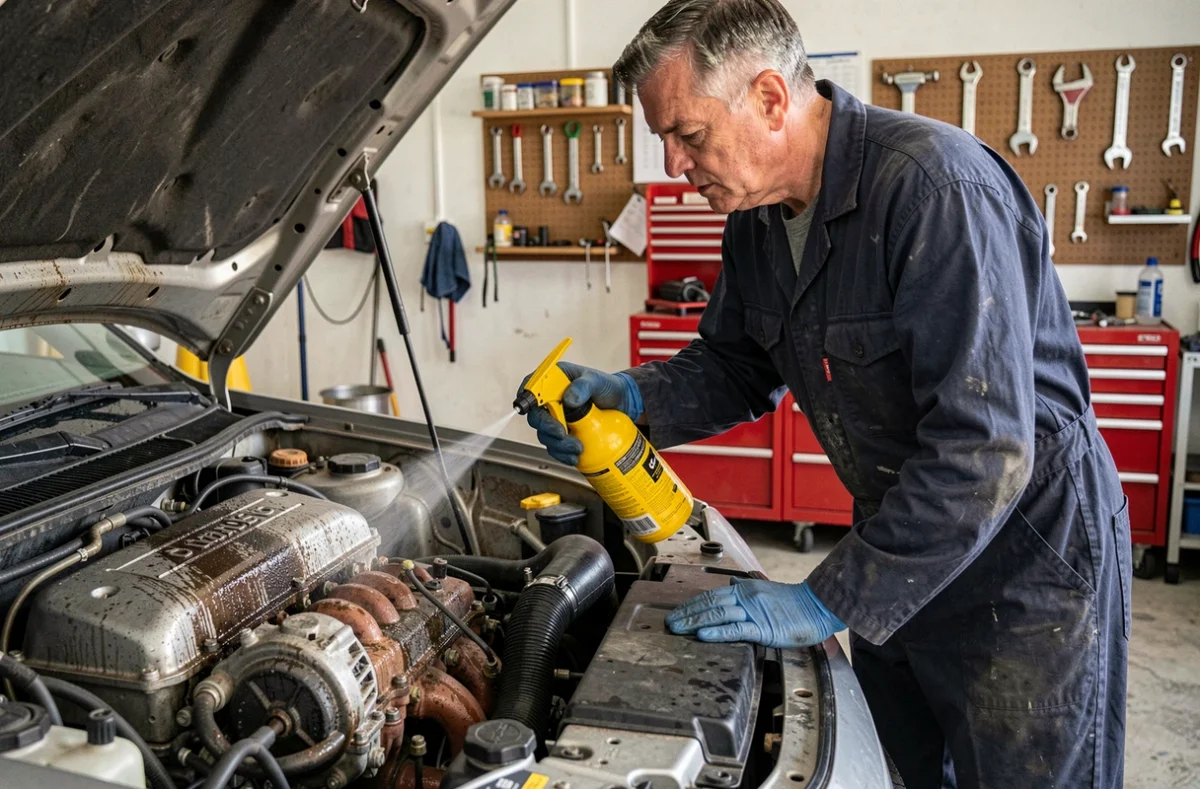
An engine compartment covered in oil presents a problem that goes beyond mere aesthetics. Greasy splashes conceal active leaks, retain abrasive dust on hoses, and create a risk of emissions near the exhaust manifold. Cleaning an oil-filled car engine requires choosing the right method based on the thickness of the deposit, as well as properly managing the effluents to comply with environmental regulations.
Degreaser, multi-purpose cleaner, or solvent: which product for which engine oil deposit
The choice of product determines the result and the risk to electronic components. Not all cleaners are equal when facing a layer of baked oil or a simple recent splash.
| Type of product | Effectiveness on fresh oil | Effectiveness on baked/carbonized oil | Risk to electronics | Rinsing required |
|---|---|---|---|---|
| Engine degreaser spray (concentrated APC type) | High | Medium (multiple passes) | Low if sprayed precisely | Yes, moderate |
| Brake cleaner (volatile solvent) | High | High | Low (quick evaporation) | No |
| Diluted dish soap | Medium | Low | Low | Yes, abundant |
| Deodorized petroleum / white spirit | High | High | Medium (attacks some plastics) | Yes, followed by additional degreasing |
The brake cleaner evaporates without leaving a residue, making it suitable for areas near connectors and sensors. However, it has no emulsifying power: dissolved oil flows down and redeposits lower if not wiped immediately.
A concentrated multi-purpose degreaser (often called APC) offers the best compromise for a completely greasy engine compartment. Diluted according to the thickness of the deposit, it emulsifies the oil and allows for controlled rinsing. Above all, it is useful to know how to clean an oil-filled engine by adapting the protocol to your vehicle.
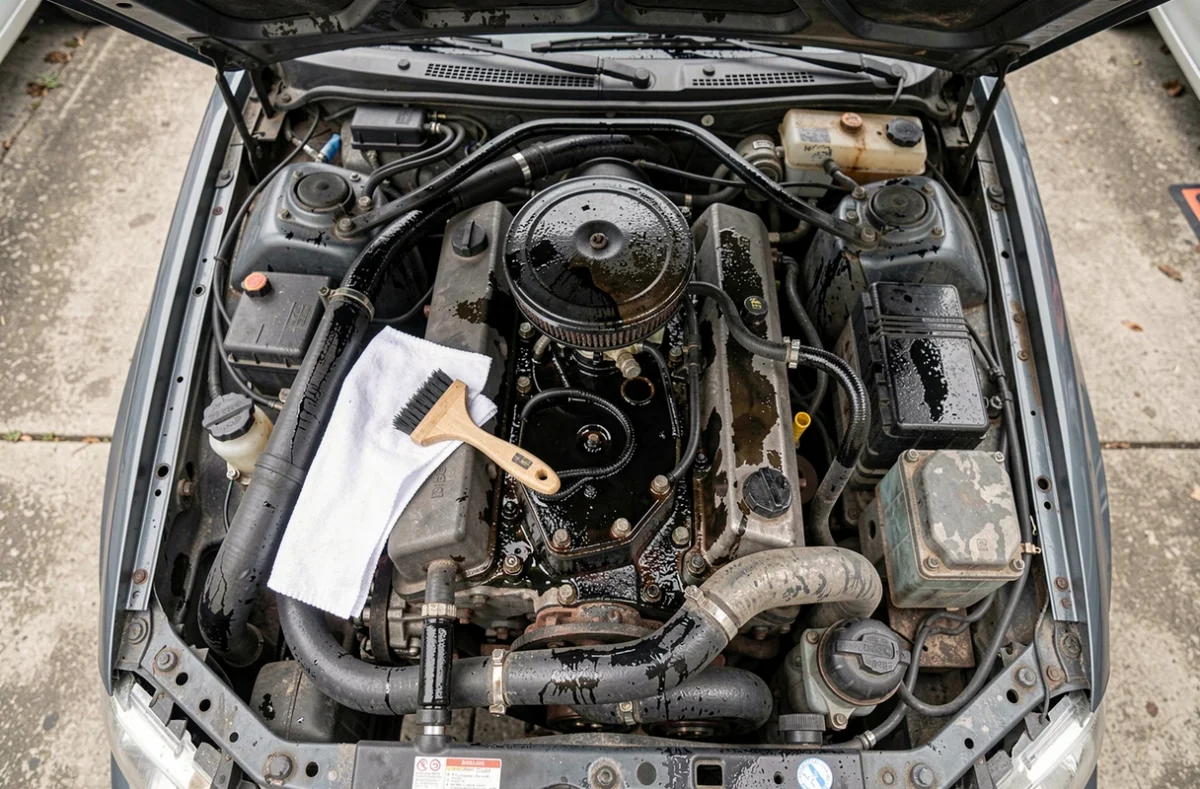
Dry cleaning or pressure washing: comparative risks for electronic components
The temptation to use a pressure washer is strong when faced with an engine block covered in black grease. This approach works, but pressurized water remains the primary cause of electrical failures post-wash.
Sensitive areas to protect before any contact with water
- The air filter housing and its flow sensor (mass air flow sensor), often located just behind the grille, which does not tolerate any infiltration well
- The connectors of the ignition coil and injectors, whose aging O-rings allow moisture to pass through capillarity
- The alternator, whose brushes and voltage regulator corrode quickly when in contact with water laden with degreaser
- The engine control unit (ECU), sometimes housed in the compartment without additional protection on vehicles made before 2010
A piece of plastic wrap is sufficient to isolate these elements. A few turns around the connector or housing, secured with a rubber band, block direct splashes.
Why dry cleaning limits damage
Dry cleaning is often preferable to rinsing. The oil present on accessible surfaces can be absorbed with microfiber cloths, a mineral absorbent, or cat litter, and then disposed of as contaminated waste. This approach avoids the dispersion of hydrocarbons and eliminates electrical risk.
On an old and thick deposit, combining both approaches yields the cleanest result: a first dry pass to remove the bulk, then a spray degreaser left to act for a few minutes, and finally a low-pressure rinse directed from top to bottom.
Step-by-step cleaning protocol for a greasy engine compartment
Working on a warm engine (not hot) helps the degreaser act without evaporating too quickly, while limiting the risk of burns.
Disconnecting the negative battery terminal is the first step. This action cuts power to all sensors and reduces the risk of short circuits during cleaning to zero.
Apply the degreaser from bottom to top, starting with the lower parts of the engine block, prevents product drips from drying on the still dry areas above. Allow the product to act for a few minutes, then agitate stubborn deposits with a synthetic bristle brush (never metal, which scratches aluminum and creates corrosion points).
The rinsing is done with a low-pressure jet or garden sprayer, always from top to bottom. Never direct the jet at air intakes or connectors, even if protected. After rinsing, remove the plastic protections and leave the hood open to allow natural evaporation before reconnecting the battery.
Wash water and used oil: what environmental regulations say
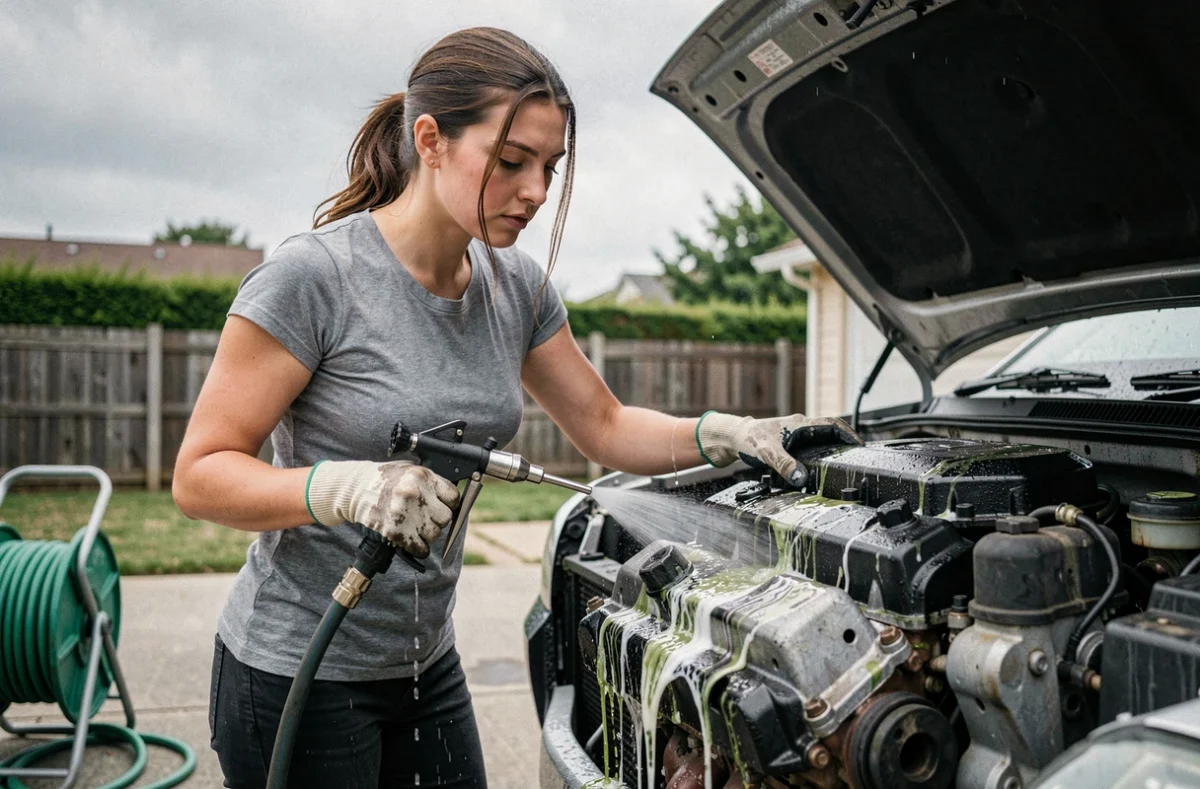
This aspect is systematically ignored in tutorials, even though it can be costly. Wash water from the engine compartment must not enter a storm drain or rainwater system. Article L216-6 of the Environmental Code applies in the case of harmful discharge into the natural environment.
In France, no national text generally prohibits washing on private property. However, local health regulations may prohibit washing on public roads and prevent any runoff into the street or networks. Working on a tarp with a lip or in a garage equipped with a retention basin remains the safest solution.
Management of waste contaminated by engine oil
Saturated cloths, absorbents, and contaminated filters must be treated as hazardous waste. They should be stored in a sealed container before being disposed of at a recycling center or an approved collection point. Mixing these residues with household waste exposes one to a fine.
The used oil recovered during cleaning follows the same process as used oil from an oil change. Recycling centers and some garages accept these volumes free of charge.
Cleaning an oil-filled engine does not require expensive equipment or advanced skills. The difference between a clean result and an electrical failure mainly lies in the protection of connectors and the choice of low-pressure rinsing rather than a direct jet. Recovering the effluents remains the point not to be neglected, both to avoid a fine and to limit the impact on water networks.