
The BPGA, or Protection and Management Box for Power Supplies, is an electronic module mounted directly on the positive terminal of the battery. Its main function: to distribute electrical current to the various controllers and components of the vehicle, while protecting each circuit with integrated fuses and relays. It can be found in most vehicles from the Stellantis group (Peugeot, Citroën, DS, Opel, Fiat).
Why a BPGA fault causes multi-system failures
The BPGA does not power a single circuit. It distributes current to the airbags, lights, air conditioning, starting system, and even the engine control unit. When an internal solder joint fails or a fuse blows, the power cut can affect multiple systems at once.
This confuses many owners: an air conditioning issue, a “circuit electrical fault” message, and a battery that discharges can all stem from a single source. A faulty BPGA generates cascading failures, complicating diagnosis if one thinks symptom by symptom instead of tracing back to the power source.
To fully understand the layout of this box and the identification of each fuse, it is possible to test the BPGA box with Les Voitures Anciennes using an illustrated guide that details each location.
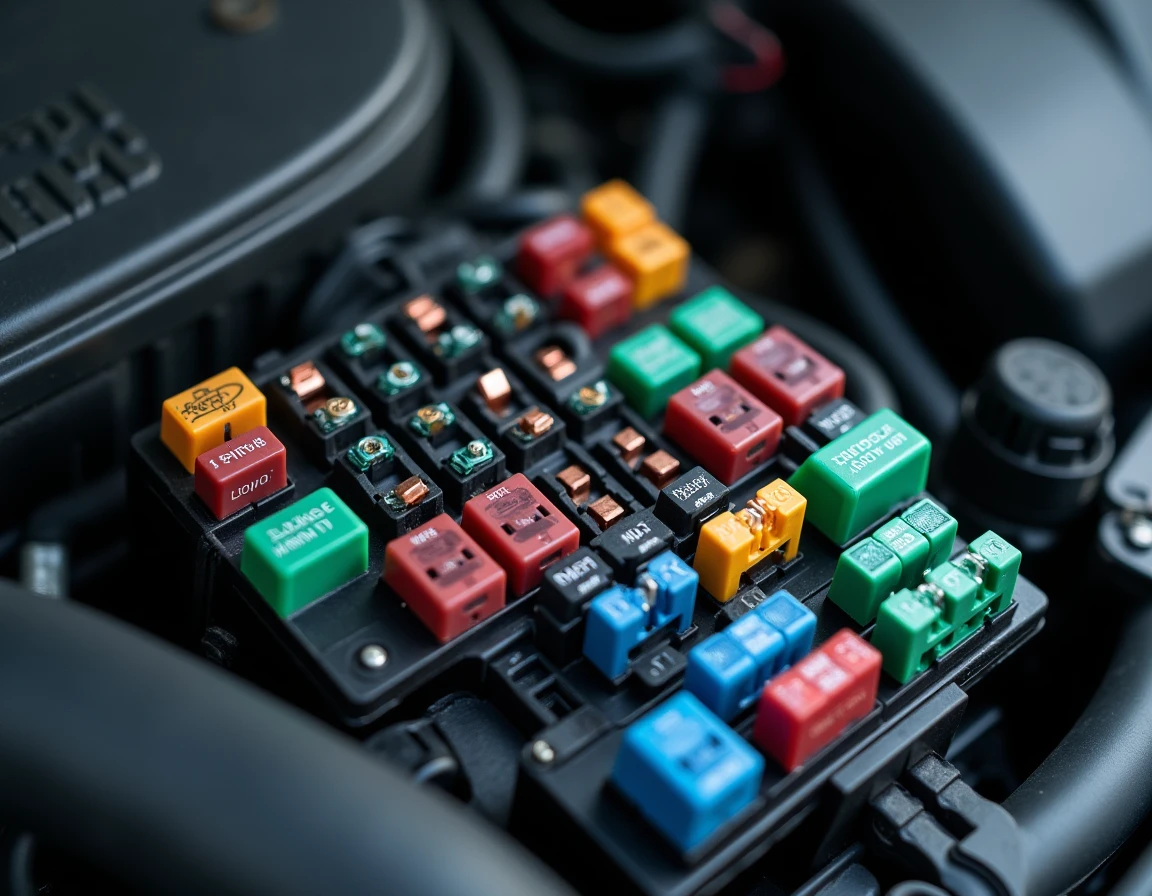
Fuses and relays of the BPGA box: identification and role of each element
Opening the cover of the BPGA reveals a dense array of fuses of various sizes and plug-in relays. Each fuse protects a specific circuit. The relays, in turn, switch the power for more demanding consumers (fuel pump, cooling fan, starter).
Reading the cover diagram
A diagram printed on the cover of the box indicates the position and size of each fuse. This identification is specific to each version of BPGA: a 3008 phase 1 does not have exactly the same allocation as a C4 or a DS4. Before any intervention, checking the correspondence between the BPGA version and the vehicle prevents replacing the wrong fuse or misinterpreting a circuit.
What a BPGA fuse protects
- Low-caliber fuses cover signaling circuits, interior lighting, and sensors (battery sensor, temperature probe).
- Medium-caliber fuses power the air conditioning, electric windows, and audio system.
- High-caliber fuses and relays manage starting, battery charging, and engine fan.
A blown fuse is visually identifiable: the internal filament is broken. However, a fuse that appears intact may show abnormal resistance, detectable only with a multimeter.
Testing the BPGA with a multimeter before replacing it
Replacing a BPGA box without prior diagnosis is a common mistake. The module is expensive, and an upstream fault in the battery, wiring, or ground can mimic a BPGA failure. A methodical test allows isolating the true culprit.
Steps for checking power supplies
- Measure the voltage at the battery terminals, both with the engine off and running, to rule out an alternator or weak battery issue.
- Check the continuity of each fuse with a multimeter in ohmmeter mode: a healthy fuse shows almost zero resistance.
- Verify the ground points of the box: a corroded terminal or a loose wire is enough to disrupt the entire module.
- Test the output voltage of each relay under load to confirm it switches correctly.
If all input power supplies are correct and the fuses are intact, but some output circuits remain dead, the problem likely lies in the internal printed circuit board of the BPGA (cold solder joints, burnt tracks).

Repair or replacement of the BPGA: decision criteria
Two options arise once the diagnosis is made. Repair involves redoing the faulty solder joints on the printed circuit board of the box. Replacement entails installing a new or refurbished BPGA, with recalibration of the charging computer.
Repair is relevant when the fault is limited to cold solder joints on identifiable components (relays, internal connectors). It costs significantly less than a new box.
Replacement is necessary if the printed circuit board shows signs of carbonization or if multiple tracks are damaged. In this case, the repair would be fragile and temporary.
Variability according to BPGA versions
Not all BPGA boxes are identical. Depending on the vehicle (308, 508, 3008, C4, DS4) and the production phase, the arrangement of internal components and fuse references vary. A replacement BPGA must match the original reference exactly, or it may be incompatible with the vehicle’s computer.
This variability also explains why some workshops refuse to repair certain versions: the density of SMD components on newer models makes soldering repairs more delicate than on earlier generations.
The trap of BPGA diagnosis: do not confuse cause and consequence
A fault code B1624 reported by the diagnostic tool points to the BPGA. This code indicates a power management fault, but it does not prove that the box itself is at fault. An aging battery, an underperforming alternator, or wiring corroded by oxidation can produce exactly the same error message on the dashboard.
The reliable approach is to test each link in the power supply chain before concluding that the BPGA is faulty. Battery, terminals, alternator, wiring, grounds: each of these elements must be validated. A new box installed on a circuit with a defective ground will fail again, sometimes within weeks.
The diagnosis of the BPGA remains an exercise in electrical rigor. Skipping steps to go faster often leads to unnecessary replacements and recurring failures that a simple methodical check of fuses and power supplies could have avoided.