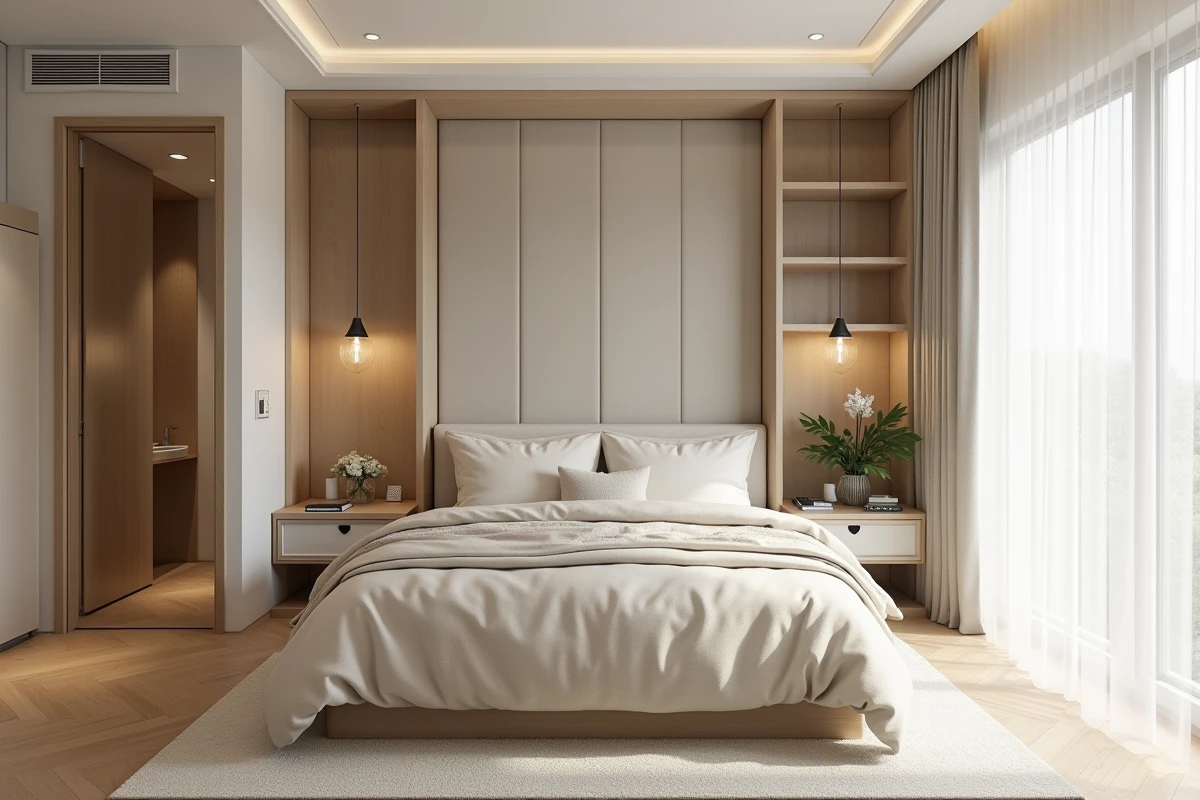
With a surface area of 15 m², a master suite can accommodate a double bed, storage space, and a water point. However, the chosen layout determines everything: circulation, light, and daily comfort. Designing a 15m2 master suite requires making choices between a dressing area, a bathroom, and a workspace, as these three functions rarely coexist.
15m2 Master Suite and Reduced Mobility: Discreet Technical Aids to Consider
Most master suite plans assume that occupants can move freely. For a senior couple or a person with reduced mobility, this assumption makes the plan unusable in a few years.
The first adaptation concerns circulation. A wheelchair requires a clear passage of at least 90 cm between the bed and the wall. In 15 m², this often necessitates shifting the bed against one side wall rather than centering it.
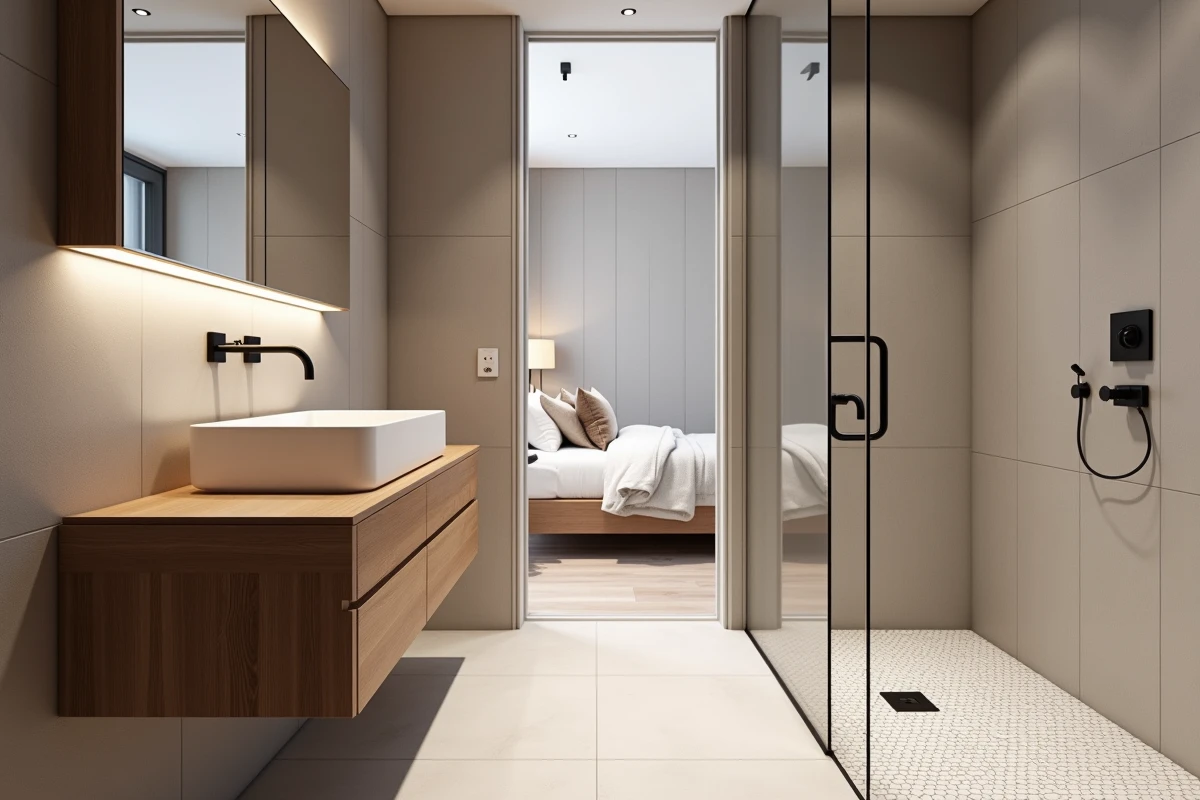
In terms of the bathroom, a walk-in shower without a step is a better alternative to a raised shower tray. The floor drain is installed flush with the tiles, and a foldable seat mounted on the wall frees up space when not in use. This type of equipment remains discreet and does not alter the modern look of the room.
- Chrome grab bars, placed next to the shower and toilet, blend in with standard towel racks.
- Motion-detecting lighting, in LED strips under the bed or along the hallway, secures nighttime movements without a switch.
- Electrical outlets and switches raised to about one meter off the ground avoid the need to bend down.
Have you noticed that round door handles are difficult to grasp with arthritic hands? Replace them with elongated lever handles, which are easier to operate. Planning for these details from the outset avoids costly modifications later.
If you are looking for a 15m2 master suite plan that incorporates these types of adaptations, it is better to start from a scaled sketch that places the shower and bed before the dressing area.
Circulation and Passage Axes in a 15m2 Master Suite
A functional plan is judged first by its empty spaces, not by its furniture. In 15 m², every centimeter of circulation counts.
The main axis connects the bedroom entrance door to the bathroom. It must remain clear at least 60 cm wide, even when the dressing doors are open. Many plans overlook this point: a dressing area with swinging doors that opens into the passage corridor makes the room impractical.
Room Shape and Bed Positioning
The elongated rectangular shape (approximately 5 m by 3 m) is better suited than a square for integrating a sleeping area and a bathroom in a row. The bed is placed at the head of the room, with the shower or bathroom at the back, and the dressing area as a partition between the two.
In a room closer to a square shape, the bed occupies an entire wall. This leaves an L-shaped free area for the water corner and storage, but the available depth for the dressing area quickly drops below 60 cm, the minimum for hanging clothes on hangers.
Why this choice between the two configurations? Because the minimum width of the room dictates the entire layout. Below 3 m wide, a centered bed placement with two side passages becomes too cramped.
Partition or Open Space: What Separation Between Bedroom and Bathroom
Open master suites, without a partition between the bed and the shower, are gaining ground. This configuration provides a significantly greater sense of space in a volume of 15 m². However, it comes with trade-offs.
Without a partition, the humidity from the shower migrates into the bedroom. A high-performance mechanical ventilation system (at least single-flow VMC) then becomes mandatory, not optional. An extractor fan in the shower area limits condensation on the furniture.
A partial partition, about 1.20 m high, offers a good compromise. It conceals sanitary equipment from the bed, blocks splashes, and allows natural light to pass through if the window is on the bathroom side.
Glass Partition or Glazed Panel
A workshop-style glass partition between the bedroom and bathroom preserves brightness while creating a true visual separation. In 15 m², it occupies less depth than a plasterboard partition (approximately 3 cm versus 7 cm). This gain may seem minimal, but over a linear length of 2.50 m, it frees up space for a low cabinet or a towel radiator.
Integrated Dressing in 15m2: Vertical Storage and Custom Modules
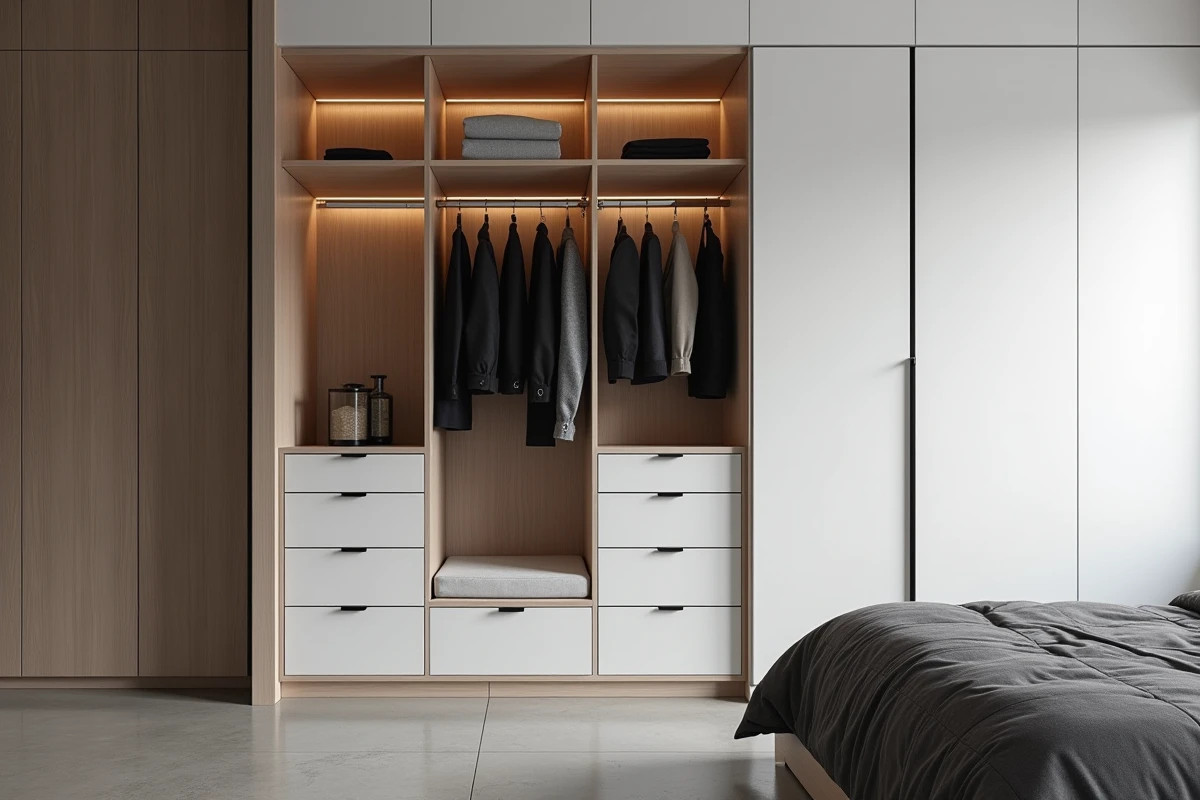
Installing a complete dressing area in a 15 m² suite requires utilizing height. Modular dressings extending to the ceiling double the storage capacity compared to a standard wardrobe of 1.80 m high.
The high rail (above 1.90 m) accommodates off-season clothing. Below, two levels of storage, one with hangers and the other with drawers or baskets, cover daily needs.
- Module depth: 60 cm for hangers perpendicular to the wall, 40 cm if the hangers are parallel (on a pull-out rail).
- Sliding doors rather than hinged ones: they do not encroach on the passage and work better in narrow spaces.
- Integrated lighting with LED strips on an opening sensor, which avoids fumbling for the switch in the morning.
A dressing area of 2.50 m long by 60 cm deep occupies 1.5 m² of floor space. This leaves more than 13 m² for the bed and bathroom, which is sufficient for a comfortable layout.
Home Automation and Automated Lighting for a Modern Master Suite
The current trend integrates home automation from the planning phase. Connected switches allow control of lighting, ventilation, and shutters from the bed, without any additional visible wiring.
A programmable ambiance dimmer is a better alternative to fixed spotlights. In the evening, warm, dim lighting promotes sleep. In the morning, a gradual increase in lighting simulates natural dawn.
Automated ventilation, coupled with a humidity sensor in the shower area, activates only when necessary. This system reduces noise compared to a continuously running VMC and better protects furniture from condensation.
Planning the electrical conduits for these systems costs little at the time of construction or major renovation. Adding them later, however, involves reopening partitions, which represents a much heavier budget and project. It is better to integrate these cable passages from the initial plan, even if the installation of connected devices occurs later.